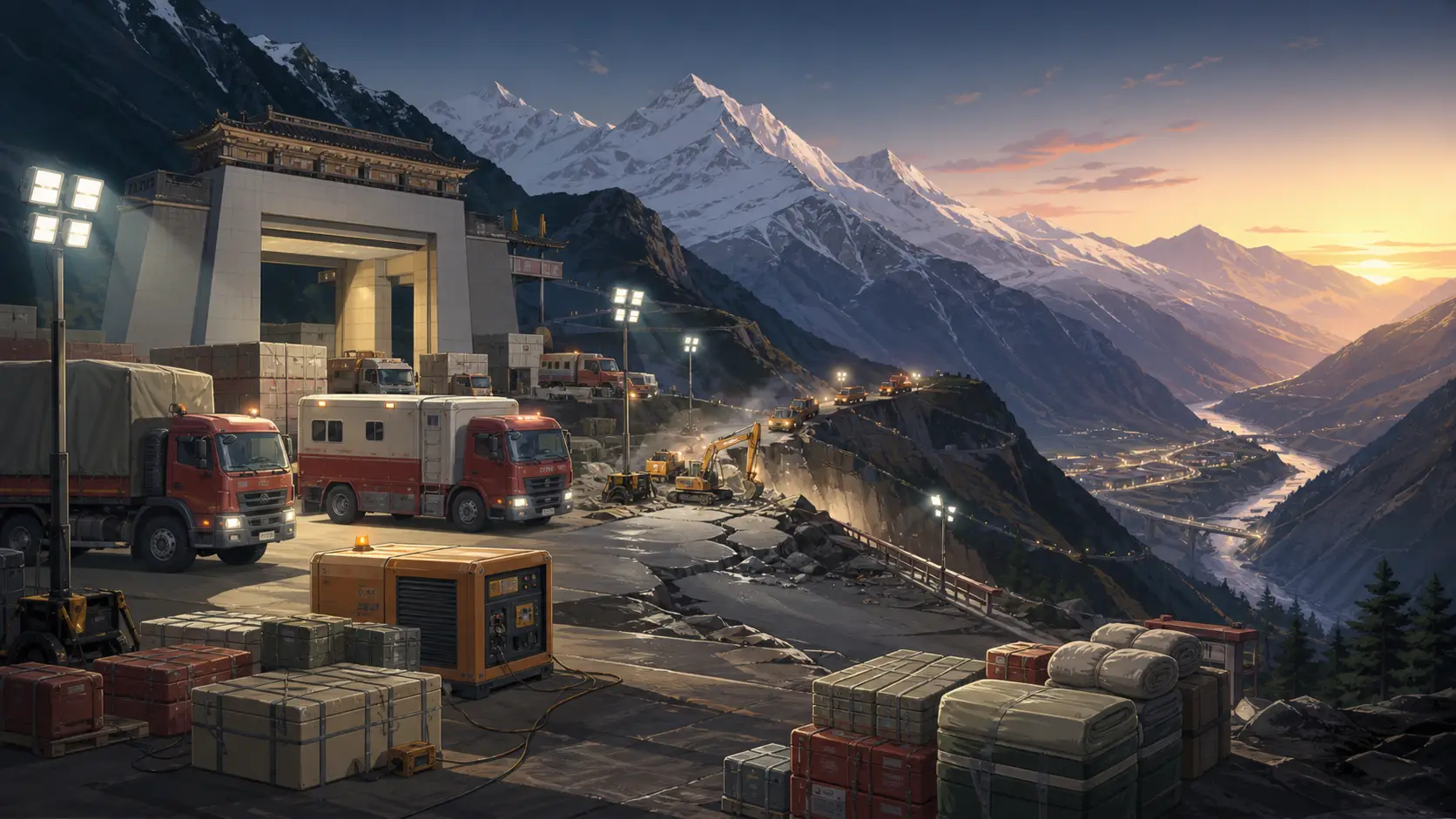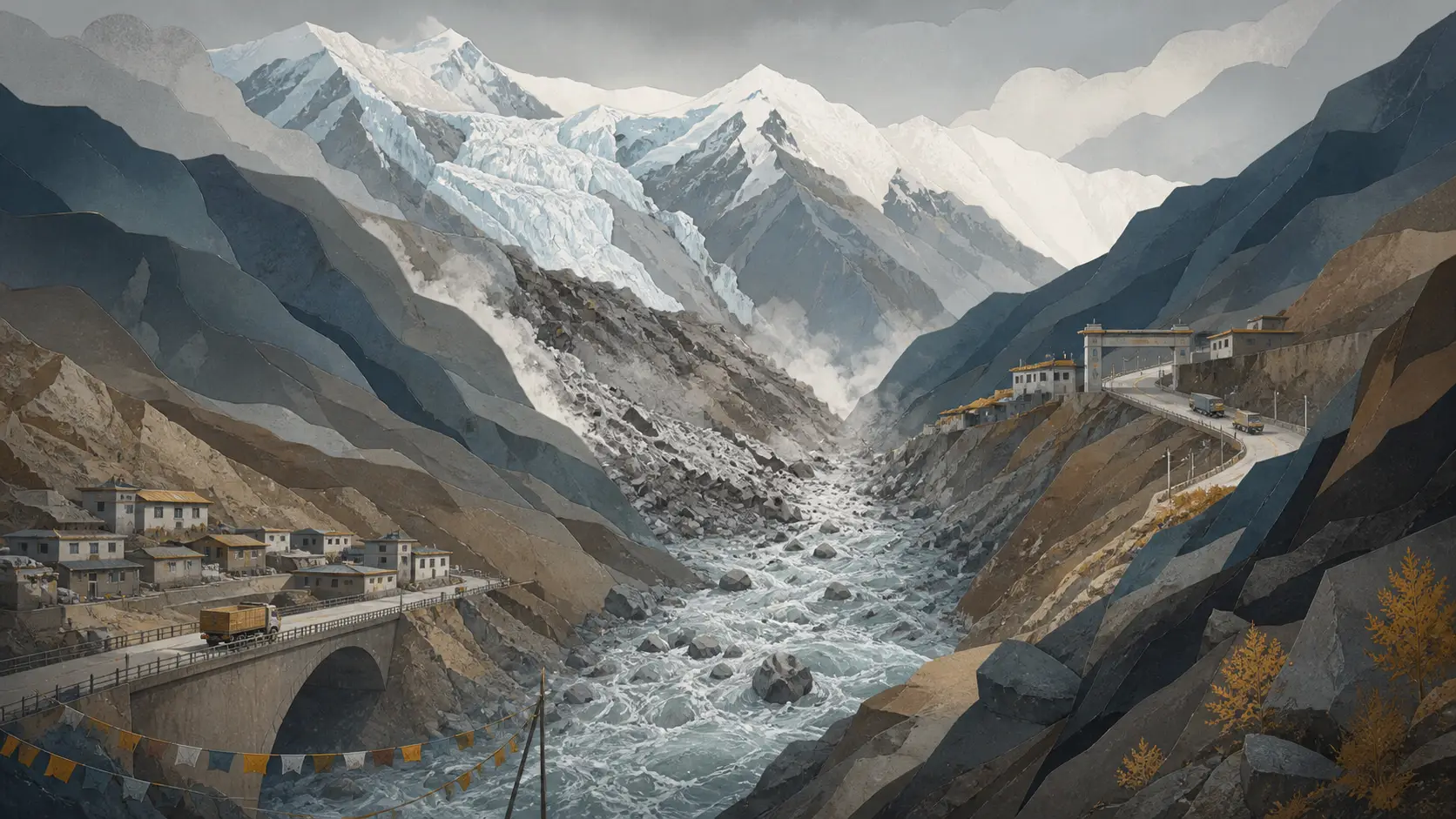
A sudden glacier-related debris flow on Aug. 26 turned a Nepal–China mountain corridor into a humanitarian emergency and a test of regional resilience. Water and mud damaged homes, roads, bridges, customs facilities and hydropower infrastructure in central Nepal, while the Gyirong border port in China’s Xizang Autonomous Region was also hit.
The immediate story is rescue. The larger story is connectivity: the same steep valleys that carry people, electricity, tourism and trade also concentrate risk. When a slope fails upstream, the consequences do not stop at a border post or a national jurisdiction.
What is confirmed, and what is still being assessed
The World Health Organization says flooding affected communities along the Bhote Koshi and Trishuli river corridors and that Nepal declared 15 municipalities disaster crisis-affected areas for three months. Its preliminary account links the surge in the Bhote Koshi to a possible ice avalanche and temporary damming of the Lhende River in the Tibet Autonomous Region of China. WHO stresses that assessments of the full damage remain ongoing.
That distinction matters. A glacier collapse, an ice-rock avalanche, a temporary natural dam and a downstream flood are related parts of a chain, but they are not interchangeable labels. The evidence available today supports describing a glacier-related mountain failure and debris flow; it does not justify treating every detail of the trigger or the final casualty count as settled.
The health picture is already serious. WHO reports around 10,000 households needing immediate relief, three health posts fully damaged, one hospital partially damaged and access to two hospitals affected. Those disruptions can outlast the news cycle because medicines, staff and patients must move through the same damaged corridors as repair crews and rescue teams.
Why a local disaster becomes a regional problem
The affected valleys are not only rural landscapes. They are transport and energy systems. Roads and bridges link border communities to markets; customs facilities mediate legal trade; hydropower assets connect mountain water to national electricity plans. The loss of one bridge can therefore create a chain of delays in food, fuel, construction materials and emergency supplies.
The Asian Imported archive on importing from China is usually about ocean freight and commercial planning. This disaster is a reminder that the last mile can be just as consequential. A container may reach a regional port on time and still be unable to cross a mountain corridor if a road, power line or customs post is gone.
Climate is part of the risk conversation, but it should be handled carefully. Warming can destabilize ice and increase the likelihood of intense rainfall in vulnerable mountain systems. It does not mean scientists can attribute a single collapse to climate change without a site-specific assessment. The practical conclusion is more immediate: infrastructure designed around historical conditions may not be adequate for compound hazards.
The next test is information, not only concrete
Nepal and China will need to restore access, but they also need shared warning and mapping systems. Upstream observations, river gauges, satellite imagery, road status and public alerts are most useful when they can cross administrative boundaries quickly. A warning that arrives after a border authority closes a gate is better than no warning, but it is not a complete regional system.
Reconstruction should likewise begin with a joint risk map. Which bridges are single points of failure? Which hydropower projects sit below unstable slopes? Which hospitals can receive patients if the main road is cut? Which border facilities can operate with backup power and satellite communications? These are operational questions, not abstract climate policy.
The response should also protect affected residents from a second-order crisis: unsafe water, interrupted medical care, lost documents and prolonged displacement. The clean-energy and minerals story in our archive shows how infrastructure debates often focus on supply and demand. Here, resilience means protecting the people and services that make a corridor function.
There is a governance lesson as well. Mountain hazards do not line up neatly with the places where budgets are approved or data is collected. Nepal’s downstream municipalities may need information held by Chinese agencies upstream, while Chinese border operators may need road and river reports from Nepal to understand access and risk. A practical cross-border protocol could define who shares alerts, who verifies them, which languages are used and how local residents receive the message. That kind of protocol is less visible than a new road, but it can save time when minutes matter.
For people living along the corridor, recovery will also be measured in ordinary services: whether children can return to school, whether farmers can reach markets, whether families can replace identity papers and whether clinics can refrigerate medicines. Those indicators deserve the same attention as the headline reopening of a trade route. They are the difference between restoring a connection on a map and restoring a functioning community.
What to watch next
Watch for updated casualty and damage assessments from Nepalese authorities, WHO and humanitarian agencies; the reopening status of roads and customs facilities; and whether Kathmandu and Beijing announce formal cooperation on reconstruction, early warning or watershed monitoring. Also watch the language used by officials: a move from emergency relief to shared risk reduction would signal that this is being treated as a regional infrastructure lesson, not only a one-off catastrophe.
The Himalayan disaster is still unfolding. The defensible lesson today is not that every mountain failure can be predicted. It is that connected infrastructure should be planned for shared hazards, with shared information and redundancy built in before the next surge arrives.
Sources
World Health Organization: 2026 Rasuwa flash floods · Associated Press reporting on the disaster · China government account of the cross-border response